Affichage des articles dont le libellé est book reviews. Afficher tous les articles

jeudi 11 décembre 2014

Moriarty by Anthony Horowitz

http://www.goodreads.com/book/show/22535533-moriarty
Internationally bestselling author Anthony Horowitz's nail-biting new novel plunges us back into the dark and complex world of Detective Sherlock Holmes and Professor James Moriarty--dubbed "the Napoleon of crime"--in the aftermath of their fateful struggle at the Reichenbach Falls.

Days after Holmes and Moriarty disappear into the waterfall's churning depths, Frederick Chase, a senior investigator at New York's infamous Pinkerton Detective Agency, arrives in Switzerland. Chase brings with him a dire warning: Moriarty's death has left a convenient vacancy in London's criminal underworld. There is no shortage of candidates to take his place--including one particularly fiendish criminal mastermind.

Chase is assisted by Inspector Athelney Jones, a Scotland Yard detective and devoted student of Holmes's methods of deduction, whom Conan Doyle introduced in The Sign of Four. The two men join forces and fight their way through the sinuous streets of Victorian London--from the elegant squares of Mayfair to the shadowy wharfs and alleyways of the Docks--in pursuit of this sinister figure, a man much feared but seldom seen, who is determined to stake his claim as Moriarty's successor.

Riveting and deeply atmospheric, Moriarty is the first Sherlock Holmes novel sanctioned by the author's estate since Horowitz's House of Silk. This tale of murder and menace breathes life into Holmes's fascinating world, again proving that once you have eliminated the impossible, whatever remains, however im- probable, must be the truth.

A summer read two years ago, Anthony Horowitz' The House of Silk was an interesting, if not particularly ground breaking, addition to the Sherlock Holmes canon, an authorised continuation of the adventures of the great detective and his 'assistant' Watson. Set somewhere within the latter part of Holmes' adventures, The House of Silk was well written, exciting and faithful homage to Conan Doyle, which boded well for any more novels Horowitz might write in this world. 

Which brings us to Moriarty, Horowitz' new novel set in the Victorian London of Doyle's hero. Where in The House of Silk Horowitz played things safe, giving us an adventure clearly meant to slot neatly into canon, in Moriarty he has broken the mold, giving us instead an enthralling look at the world that existed between Holmes and Moriarty fateful fall at the Reichenbach and the reappearance of Holmes a few years later. With Holmes and Watson off the stage, Horowitz turns his attention to two new characters. One, Athelney Jones, is actually a character from Doyle's work, a Scotland Yard detective who appeared in The Sign of Four. Here, Horowitz is able to develop the character much further, using what Doyle wrote about him to give the man a clever backstory that explains his devotion to Holmes' methods. Jones becomes our Sherlock Holmes surrogate, but instead of just creating a cliché, Horowitz breathes life into the detective by giving him a family, something that Holmes obviously lacks. 

The second character is Frederick Chase, an investigator for Pinkertons, the legendary American detective force, sent to Europe to pursue an American crimelord determined to step into the gulf left behind by Moriarty's death. This investigation brings the two men together and from  there the story escalates, from Reichenbach to London, through the darkest corners of the criminal underworld. Brutality and terror stalk the streets of the capital and it seems that only Chase and Jones will be able to bring the true culprit to justice. 

What was already an enthralling, exciting, gripping mystery tale takes on a much greater dimension, though, in the last third of the novel. Horowitz pulls off a fantastic coup, setting up and delivering on an absolutely terrific twist that caught me totally by surprise but made perfect sense once it was revealed. I won't give anything about this twist away, but suffice it to say, I personally found it totally unexpected. Horowitz really delivers with Moriarty, showing that there are still interesting and surprising tales to be told in the Holmes universe. I hope he gets the opportunity to do so in the future. 

I gave Moriarty 4 stars.

mercredi 10 décembre 2014

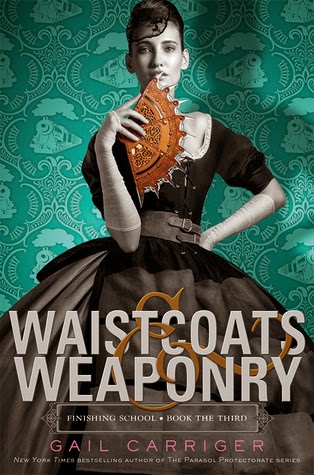
Waistcoats and Weaponry by Gail Carriger


http://www.goodreads.com/book/show/20980648-waistcoats-weaponry

Class is back in session...
 
Sophronia continues her second year at finishing school in style--with a steel-bladed fan secreted in the folds of her ball gown, of course. Such a fashionable choice of weapon comes in handy when Sophronia, her best friend Dimity, sweet sootie Soap, and the charming Lord Felix Mersey stowaway on a train to return their classmate Sidheag to her werewolf pack in Scotland. No one suspected what--or who--they would find aboard that suspiciously empty train. Sophronia uncovers a plot that threatens to throw all of London into chaos and she must decide where her loyalties lie, once and for all.

Gather your poison, steel tipped quill, and the rest of your school supplies and join Mademoiselle Geraldine's proper young killing machines in the third rousing installment in the New York Times bestselling Finishing School Series by steampunk author, Gail Carriger

Gail Carriger burst onto the fantasy scene a few years ago with her Parasol Protectorate series, a fantastic historical urban fantasy, full of great characters, humourous dialogue and exciting action scenes. A kind-of-prequel - set earlier than the first series though initially seemingly without any of the same characters -  the Finishing School Series continues in the steampunk vein of the first series, adding the setting of a floating espionage school masquerading as a finishing school. While the first book did not blow me away, I enjoyed it enough to carry on. The series has got steadily better and this, the third book, is fantastic.

Following Sophronia and her friends once again, Waistcoats and Weaponry sees major changes in the status quo, as werewolves plot rebellion and vampires strike at mechanicals. Forced to take possession of a runaway train, Sophronia and her friends go up once again against the Picklemen. There are major changes in store before the book reaches its end, all of which Carriger handles with her usual humour. Her writing continues to be a delight, full of wit and funny turns of phrase, and Sophronia really grows as a character, willing to go once more against the prevailing societal pressures of her time. Her relationship with Soap is especially well handled here 

Setting up the final book in the series nicely, Waistcoats and Weaponry finally begins to bring the Finishing School Series up to the same level as the Parasol Protectorate. 

I gave Waistcoats and Weaponry 4 stars.

lundi 8 décembre 2014

The Buried Life by Carrie Patel

https://www.goodreads.com/book/show/20263206-the-buried-life?from_search=true
 
The gaslight and shadows of the underground city of Recoletta hide secrets and lies. When Inspector Liesl Malone investigates the murder of a renowned historian, she finds herself stonewalled by the all-powerful Directorate of Preservation – Recoletta’s top-secret historical research facility.
 
When a second high-profile murder threatens the very fabric of city society, Malone and her rookie partner Rafe Sundar must tread carefully, lest they fall victim to not only the criminals they seek, but the government which purports to protect them. Knowledge is power, and power must be preserved at all costs…


The Buried Life is one of those books that I had to read at the right time to get into - I had tried to read it a few months ago and it didn't quite gel for me - that may be due to the fact that I had read a few similar books around that time. Whatever the reason, I put it aside but it had interested me enough for me to want to pick it back up again, which I did back in October (yes, I know, bad blogger, bad! :))

A fantasy murder mystery to start with, The Buried Life could be termed science fantasy - while not made obvious, there are clear indications that the underground world of the book is our future, with books and cultural references serving as clear nods to our own world. This makes for a nice twist on the Victorian-esque, gaslight ambiance the book is set in. While the worldbuilding was good, where The Buried Life excelled was in the characters. I really enjoyed getting to know Liesl, Rafe and Jane: a washer-woman who is not mentioned in the blurb but who I would say is probably more important to the plot and more interesting as a character than the other two. Her Relationship with Roman proves to be a hinge for the story and her actions have major effects on the future of Recoletta.

While the murder mystery is tied up nicely, providing a pleasant sense of closure to that part of the book, there are larger events that take over towards the end and set up the stage nicely for the follow-up (due out in February). I for one will be eagerly waiting to download it to my Kindle on the day of release!

I gave The Buried Life 4 stars.

vendredi 5 décembre 2014

Fool's Assassin by Robin Hobb

 
Nearly twenty years ago, Robin Hobb burst upon the fantasy scene with the first of her acclaimed Farseer novels, Assassin’s Apprentice, which introduced the characters of FitzChivalry Farseer and his uncanny friend the Fool. A watershed moment in modern fantasy, this novel—and those that followed—broke exciting new ground in a beloved genre. Together with George R. R. Martin, Robin Hobb helped pave the way for such talented new voices as Scott Lynch, Brandon Sanderson, and Naomi Novik.

Over the years, Hobb’s imagination has soared throughout the mythic lands of the Six Duchies in such bestselling series as the Liveship Traders Trilogy and the Rain Wilds Chronicles. But no matter how far she roamed, her heart always remained with Fitz. And now, at last, she has come home, with an astonishing new novel that opens a dark and gripping chapter in the Farseer saga.

FitzChivalry—royal bastard and former king’s assassin—has left his life of intrigue behind. As far as the rest of the world knows, FitzChivalry Farseer is dead and buried. Masquerading as Tom Badgerlock, Fitz is now married to his childhood sweetheart, Molly, and leading the quiet life of a country squire.

Though Fitz is haunted by the disappearance of the Fool, who did so much to shape Fitz into the man he has become, such private hurts are put aside in the business of daily life, at least until the appearance of menacing, pale-skinned strangers casts a sinister shadow over Fitz’s past . . . and his future.

Now, to protect his new life, the former assassin must once again take up his old one. . . .


Before I start this review, it is important to understand that the books that make up Robin Hobb's vast tapestry - from the original Assassin's Apprentice to the more recent Blood of Dragons - are some of my favourite fantasy novels. I adore Hobb's writing style and of everything she has written the adventures of Fitz and the Fool have a special place in my heart. I read the second Fitz trilogy at a very important time in my life (the few years while I was dating, getting engaged to and marrying my wife) and as such it is very difficult for me to be anywhere close to objective when it comes to writing down my thoughts about this return to Fitz.

You have been warned! :)

Fool's Assassin picks up a few years after the events of Fool's Fate. As with many other Robin Hobb's books, this is a slow burn as we settle back into Fitz' skin and see the life he has built for himself in his father's old estate. For once, we see Fitz enjoying his life - he has Molly, he is rebuilding his relationship with his daughter and he has found some kind of balance with the demands of the throne and his former mentor Chade. It was such a joy to see all of this, to rediscover these characters, to watch Fitz finally enjoy a moment of happiness with Molly, that the opening chapters, while extremely slow paced flew by. That is not to say that nothing happens in these early pages - almost from the get-go we are introduced to a mystery that has burst into Fitz' life: a pale-faced messenger who is murdered before she can tell Fitz why she is here. For anyone who is a fan, it is easy to guess at least a vague idea of the identity of the messenger and the message she is carrying.

The first book covers quite a large swath of time, allowing Hobb to deal with something that happened in a prior novel - Fitz was healed by an overwhelming use of the Skill and as such he is not aging at the normal rate. Hobb handles this very carefully as he watches his wife Molly grow older while he remains - physically, at least - in his early thirties. This also allows for one of the best fakeouts of the book as Molly seems to descend into senility, convinced that she is pregnant while showing no outward signs. As months and then years go past, it becomes tragically clear that the whole thing is in her mind... Until suddenly she gives birth!

And this is where Hobb lays to rest any fears those who are not rabid fans like me that she is not simply retelling the same story again. For the first time in the Fitz series, we are provided another voice - that of Bee, Fitz' strange, wonderful and miraculous baby girl. From the moment she is born, we are given alternating viewpoints of Fitz and his daughter, giving us extra insight into the character we know and love as another person describes him to us. Bee is a great new character, whose mysterious origin seemed obvious to me, but that was part of the charm, waiting for the other characters to wake up and realise who she had to be. I won't give away exactly who and what Bee really is, but the revelation right at the end is definitely worth it.

As usual, Hobb does a great job of dragging you behind Fitz' (and later Bee's) eyes and making you feel for them both. Their emotions are so real, so visceral, which is what has gained Robin Hobb so many fans over the years. We not only read about Fitz, we truly become him, because Hobb's writing is so immediate and yet so lush that it is almost impossible not to get swept up in it. As the book progresses, Fitz' simple happy life is slowly chipped away, notably through the arrival of two characters who I am sure we will all love to hate (FitzVigilant and Shun), so the emotional heft of the work really picks up as we reach the conclusion.

The conclusion... Heartbreaking, exciting, glorious and inevitable all at once, Hobb manages to bring a beloved character back and moments later tears Fitz' heart out. I dare any fan of these characters not to let slip an involuntary gasp when Fitz realises who exactly he has stabbed in town (I'll keep from spoiling who exactly that is!) As Fitz ominously explains in the epilogue: the darkest time of my life had begun.

A slow-moving, glorious exploration of a truly amazing character, Fool's Assassin is a triumphant return to the world of Fitz and the Fool, to the world of Buckkeep and the Mountain Kingdom, to the world of assassins, Skillmasters and dragons. Hobb does a great job of reintroducing her characters in such a way that even someone who has never read any of the other books would be able to pick it up and quickly understand what is happening. While it starts off slow, the book plays with expectations, introducing a new viewpoint for the first time and creating, in Bee Farseer, a wonderful new character. The ending, heartrending and hugely exciting, bodes badly for Fitz in the future, but based on the last two trilogies, that bodes well for all of us readers as this new trilogy progresses.


Without hesitation, I give Fool's Assassin 5 Witness Stones out of 5.

jeudi 4 décembre 2014

Star Wars: Tarkin by James Luceno


A long time ago in a galaxy far, far away. . . .

Bestselling Star Wars veteran James Luceno gives Grand Moff Tarkin the Star Wars: Darth Plagueis treatment, bringing a legendary character from A New Hope to full, fascinating life.

He’s the scion of an honorable and revered family. A dedicated soldier and distinguished legislator. Loyal proponent of the Republic and trusted ally of the Jedi Order. Groomed by the ruthless politician and Sith Lord who would be Emperor, Governor Wilhuff Tarkin rises through the Imperial ranks, enforcing his authority ever more mercilessly . . . and zealously pursuing his destiny as the architect of absolute dominion.

Rule through the fear of force rather than force itself, he advises his Emperor. Under Tarkin’s guidance, an ultimate weapon of unparalleled destruction moves ever closer to becoming a terrifying reality. When the so-called Death Star is completed, Tarkin is confident that the galaxy’s lingering pockets of Separatist rebellion will be brought to heel—by intimidation . . . or annihilation.

Until then, however, insurgency remains a genuine threat. Escalating guerrilla attacks by resistance forces and newfound evidence of a growing Separatist conspiracy are an immediate danger the Empire must meet with swift and brutal action. And to bring down a band of elusive freedom fighters, the Emperor turns to his most formidable agents: Darth Vader, the fearsome new Sith enforcer as remorseless as he is mysterious; and Tarkin—whose tactical cunning and cold-blooded efficiency will pave the way for the Empire’s supremacy . . . and its enemies’ extinction.

As the second novel released in Disney's new Star Wars Expanded Universe, Tarkin has a lot riding on it. While A New Dawn - the first book in the new canon - acted as a prequel to Rebels, the new cartoon series, Tarkin takes place in the run up to A New Hope, giving us a glimpse into  the mind of a favourite character and using a lot more well-known characters than that first book, not the least of which are Darth Vader and the Emperor himself. As such, Tarkin was going to give us much more of an idea what the Star Wars new canon would look like and how much of what had gone before was being done away with.

Beyond that, though, Tarkin obviously had to be a good story. And it delivers, in spades! Telling a story of fledgling rebels playing a game of cat and mouse with Tarkin and Vader, both of whom are far from the established figures in Imperial power that they will become, Tarkin also delves into the titular character's history, much as Darth Plagueius did in the old canon. With lots of little nods to that former canon, proving that the new Story Group is going to do exactly as promised - delving into the old stories for inspiration and elements while not allowing themselves to get bogged down in minutiae - Tarkin tells a compelling story. Full of double crosses, surprises, Force powers and space battles, Tarkin is Star Wars done well, while also giving a nice depth to this man we love to hate.

I said at the end of my review of A New Dawn that I hoped the upcoming novels would do more to ignite this new expanded universe. Tarkin does that. I for one can't wait for Heir to the Jedi, a Luke Skywalker starring novel told in first person written by Kevin Hearne, one of the greatest urban fantasy writers working today!

I gave Star Wars: Tarkin 4 stars.

samedi 29 novembre 2014

Liar, Temptress, Soldier, Spy by Karen Abbott


Karen Abbott, the New York Times bestselling author of Sin in the Second City and “pioneer of sizzle history” (USA Today), tells the spellbinding true story of four women who risked everything to become spies during the Civil War.

Karen Abbott illuminates one of the most fascinating yet little known aspects of the Civil War: the stories of four courageous women—a socialite, a farmgirl, an abolitionist, and a widow—who were spies.

After shooting a Union soldier in her front hall with a pocket pistol, Belle Boyd became a courier and spy for the Confederate army, using her charms to seduce men on both sides. Emma Edmonds cut off her hair and assumed the identity of a man to enlist as a Union private, witnessing the bloodiest battles of the Civil War. The beautiful widow, Rose O’Neale Greenhow, engaged in affairs with powerful Northern politicians to gather intelligence for the Confederacy, and used her young daughter to send information to Southern generals. Elizabeth Van Lew, a wealthy Richmond abolitionist, hid behind her proper Southern manners as she orchestrated a far-reaching espionage ring, right under the noses of suspicious rebel detectives.

Using a wealth of primary source material and interviews with the spies’ descendants, Abbott seamlessly weaves the adventures of these four heroines throughout the tumultuous years of the war. With a cast of real-life characters including Walt Whitman, Nathaniel Hawthorne, General Stonewall Jackson, detective Allan Pinkerton, Abraham and Mary Todd Lincoln, and Emperor Napoleon III, Liar, Temptress, Soldier, Spy draws you into the war as these daring women lived it.

I love reading about American history, as shown by my current project to read a biography of each American President. While I am interested in the Civil War era, I have very little interest in military history that describes in detail battles and the movement of armies, so it is difficult to find a book set in that era that catches my attention. When I saw this book, promising an original look at the era, through the eyes of four uncommon women, I jumped on it immediately. 

Liar, Temptress, Soldier, Spy works well, interweaving four different storylines in an exciting and attention grabbing way, keeping the story moving through the years of the war. Of the four women, two support the Union and two support the Confederacy, allowing Abbott to carefully explore the effects of the war on both sides. Providing a feminine perspective and showing how vital they were to the war effort is a fine way of giving a new spin to this well known period of history, one that Abbott pulls off with aplomb. Although at times the writing became a little dry, especially when Abbott deals with the dreaded battles, overall the book keeps the attention all the way through to the - sometimes tragic - end. Definitely recommended to anyone interested in this era and looking for an original spin on it.

I gave Liar, Temptress, Soldier, Spy 4 stars.

vendredi 28 novembre 2014

The Woman Who Would Be King by Kara Cooney


An engrossing biography of the longest-reigning female pharaoh in Ancient Egypt and the story of her audacious rise to power in a man’s world.

Hatshepsut, the daughter of a general who took Egypt's throne without status as a king’s son and a mother with ties to the previous dynasty, was born into a privileged position of the royal household. Married to her brother, she was expected to bear the sons who would legitimize the reign of her father’s family. Her failure to produce a male heir was ultimately the twist of fate that paved the way for her inconceivable rule as a cross-dressing king. At just twenty, Hatshepsut ascended to the rank of king in an elaborate coronation ceremony that set the tone for her spectacular twenty-two year reign as co-regent with Thutmose III, the infant king whose mother Hatshepsut out-maneuvered for a seat on the throne. Hatshepsut was a master strategist, cloaking her political power plays with the veil of piety and sexual expression. Just as women today face obstacles from a society that equates authority with masculinity, Hatshepsut had to shrewdly operate the levers of a patriarchal system to emerge as Egypt's second female pharaoh.

Hatshepsut had successfully negotiated a path from the royal nursery to the very pinnacle of authority, and her reign saw one of Ancient Egypt’s most prolific building periods. Scholars have long speculated as to why her images were destroyed within a few decades of her death, all but erasing evidence of her rule. Constructing a rich narrative history using the artifacts that remain, noted Egyptologist Kara Cooney offers a remarkable interpretation of how Hatshepsut rapidly but methodically consolidated power—and why she fell from public favor just as quickly. The Woman Who Would Be King traces the unconventional life of an almost-forgotten pharaoh and explores our complicated reactions to women in power.

Basing her conclusions on the few remaining artefacts and allowing herself a lot of leeway to fill in the gaps, Kara Cooney has created an enthralling portrait of an amazing woman in The Woman Who Would Be King, a biography of the second female pharaoh, Hatshepsut. From her birth and training as a priestess to her co-regency with her stepson, Cooney traces the steps Hatshepsut took in order to both secure her position and then consolidate it, identifying her as unique - a woman who was able to gain the throne in a male-dominated society during a time of peace rather than war. 

Cooney makes some interesting points, showing how both the later Pharaohs and the even later Egyptologists twisted the few elements we have about this remarkable woman into the story of a power-mad temptress who seized the throne from the rightful heir and held it against the judgement of her entire society. The story Cooney tells is much more complex, requiring a knowledge of Egyptian culture and mores, especially when it comes to female sexuality. A true narrative history, The Woman Who Would Be King is far from a dry exploration of ancient artefacts, but instead is an interesting and exciting dive into a world that seems incredibly alien from our point of view. And yet Cooney manages to make the narrative contemporary, showing how the way we look at Hatshepsut affects the way we look at woman in positions of power even today. 

I gave The Woman Who Would Be King 4 stars.

jeudi 6 novembre 2014

Doctor Who: The Blood Cell by James Goss


"Release the Doctor — or the killing will start."

An asteroid in the furthest reaches of space - the most secure prison for the most dangerous of criminals. The Governor is responsible for the worst fraudsters and the cruellest murderers. So he's certainly not impressed by the arrival of the man they're calling the most dangerous criminal in the quadrant. Or, as he prefers to be known, the Doctor.

What does impress the Governor is the way the new prisoner immediately sets about trying to escape. And keeps trying. Finally, he sends for the Doctor and asks him why? But the answer surprises even the Governor. And then there's the threat — unless the Governor listens to the Doctor, a lot of people will die.

Who is the Doctor and what's he really doing here? Why does he want to help the Governor? And who is the young woman who comes every day to visit him, only to be turned away by the guards?

When the killing finally starts, the Governor begins to get his answers...


A very strange Doctor Who story, The Blood Cell is told entirely through the eyes of a secondary character – the Governor – who encounters the Doctor and Clara when a strange old man is incarcerated in the prison he runs. As strange things begin to happen and the prison turns against the inmates and the guards, the Governor is forced to turn to the Doctor for help…

As a Doctor Who story told through the eyes of a secondary character, The Blood Cell works. As a science fiction story disassociated from the Doctor Who franchise, The Blood Cell works even better.  The Governor is an interesting narrator, full of contradictions and secrets that beg to be revealed. The situation - an inescapable prison where prisoners are disappearing - dealt cleverly with some basic sci-fi tropes. As the story progresses and the stakes mount, I for one found the story gripping, wondering who was behind the prison's problems, who the Governor really was and how the whole thing was going to resolve itself. 

Unfortunately, as a Twelfth Doctor story, The Blood Cell fails at one vital hurdle – the Doctor himself. While I could definitely see the Eleventh or Tenth Doctors acting in the way this Doctor does, what we have seen of Capaldi so far just does not gel with this wise-cracking, pop-culture spouting character. This Doctor does not have the darkness that Capaldi has brought to the role and while his relationship with Clara does share some of the antagonism of the on-screen partners, there was definitely something essential missing. If you can tell yourself that this is a lost Matt Smith story, great. If not, you may have the same problems with The Blood Cell that I did.
 
I gave The Blood Cell 3 stars. 

mercredi 5 novembre 2014

Edge of Eternity by Ken Follett


EDGE OF ETERNITY is the sweeping, passionate conclusion to Ken Follett’s extraordinary historical epic, The Century Trilogy.

Throughout these books, Follett has followed the fortunes of five intertwined families – American, German, Russian, English, and Welsh – as they make their way through the twentieth century. Now they come to one of the most tumultuous eras of all: the enormous social, political, and economic turmoil of the 1960s through the 1980s, from civil rights, assassinations, mass political movements and Vietnam to the Berlin Wall, the Cuban Missile Crisis, presidential impeachment, revolution – and rock and roll.

East German teacher Rebecca Hoffman discovers she’s been spied on by the Stasi for years and commits an impulsive act that will affect her family for the rest of their lives.…George Jakes, the child of a mixed-race couple, bypasses a corporate law career to join Robert F. Kennedy’s Justice Department, and finds himself in the middle not only of the seminal events of the civil rights battle, but a much more personal battle of his own.…Cameron Dewar, the grandson of a senator, jumps at the chance to do some official and unofficial espionage for a cause he believes in, only to discover that the world is a much more dangerous place than he’d imagined.…Dimka Dvorkin, a young aide to Nikita Khrushchev, becomes a prime agent both for good and for ill as the United States and the Soviet Union race to the brink of nuclear war, while his twin sister, Tania, carves out a role that will take her from Moscow to Cuba to Prague to Warsaw – and into history.

As always with Follett, the historical background is brilliantly researched and rendered, the action fast-moving, the characters rich in nuance and emotion. With the hand of a master, he brings us into a world we thought we knew but now will never seem the same again.


Ken Follett’s sweeping Century trilogy has been a must read for me ever since the first book came out a few years ago. A hugely ambitious undertaking (telling the story of the 20th century through the eyes of a handful of families), the trilogy has been a potent mixture of historical fiction, thriller, romance, saga and coming-of-age tale. I’ve loved the other two books and had been waiting impatiently for the final instalment to be released. So I was delighted to hear that Edge of Eternity was being released at the end of this year and it was placed firmly at the top of my TBR. 

Edge of Eternity does a great job of wrapping up the threads laid down in the last books, as the first generation explored in Fall of Giants give way to the younger. For many of those characters, we see them shuffle off the stage, while their children, grand-children and even great grand-children step up and shoulder the burden. Although a large part of the book centres on the Cold War, especially the effect the Iron Curtain and Berlin Wall has on the families, Follett also explores the Cuban Missile Crisis, Kennedy’s assassination, the Civil Rights movement and the rise of the liberal agenda (gay rights being one of the themes explored). Through a couple of his characters, he also delves into an integral part of society in the second part of the 20th century – the rock star. 

Once again, Follett manages to juggle a huge number of characters with aplomb, giving each of them distinct personalities, stories and lives, though the huge canvas does stop him from giving them as much depth as he might have otherwise. I loved it from beginning to end, especially enjoying his portrayal of Kennedy and Johnson – Follett makes it clear that Kennedy was much less interested in civil rights at the beginning than he would later be considered to have been and that Johnson, despite his numerous mistakes, did a lot for the movement in his first few months in office. A great, sweeping portrayal of a tumultuous few decades, Edge of Eternity is great historical fiction done well.

I gave Edge of Eternity 4 stars.

lundi 3 novembre 2014

The Fortune Hunter by Daisy Goodwin


In 1875, Sisi, the Empress of Austria is the woman that every man desires and every woman envies.

Beautiful, athletic and intelligent, Sisi has everything - except happiness. Bored with the stultifying etiquette of the Hapsburg Court and her dutiful but unexciting husband, Franz Joseph, Sisi comes to England to hunt. She comes looking for excitement and she finds it in the dashing form of Captain Bay Middleton, the only man in Europe who can outride her. Ten years younger than her and engaged to the rich and devoted Charlotte, Bay has everything to lose by falling for a woman who can never be his. But Bay and the Empress are as reckless as each other, and their mutual attraction is a force that cannot be denied.

Full of passion and drama, THE FORTUNE HUNTER tells the true story of a nineteenth century Queen of Hearts and a cavalry captain, and the struggle between love and duty.


A historical romance, The Fortune Hunter is not really my usual fare. The main thing that caught my attention in the blurb was the mention of Sisi, Empress of Austria. Here in France, Sisi is quite popular and well-known because of a trilogy of movies that trace her life, released in the 1950s and regularly shown on French television. I’ve never watched the movies and knew very little about her, so when this showed up on an upcoming releases post on a friendly blog, I decided to pick it up.

I actually enjoyed The Fortune Hunter a lot more than I had expected. The characters are well-drawn, especially Charlotte who is much more of a central figure than the blurb would have you believe. It is actually Sisi who takes a back seat, acting more as an obstacle in the way of Charlotte and Bay’s love story than a heroic figure in and of herself. Goodwin does a great job of bringing all three characters to life, taking liberties with timelines and lifestories in order to create an intriguing and surprisingly gripping story of love, desire and society. I loved the character of Charlotte and enjoyed the fact that in the end she is able to maintain her liberty and interests without giving up her romantic life. I definitely recommend it to anyone looking for a historical romance with some great characters.
 
I gave The Fortune Hunter 4 stars.